


THE PROTECTION REGIME OF LAKE BAIKAL AND
METHODS FOR IMPROVING THE ENVIRONMENTAL SITUATION
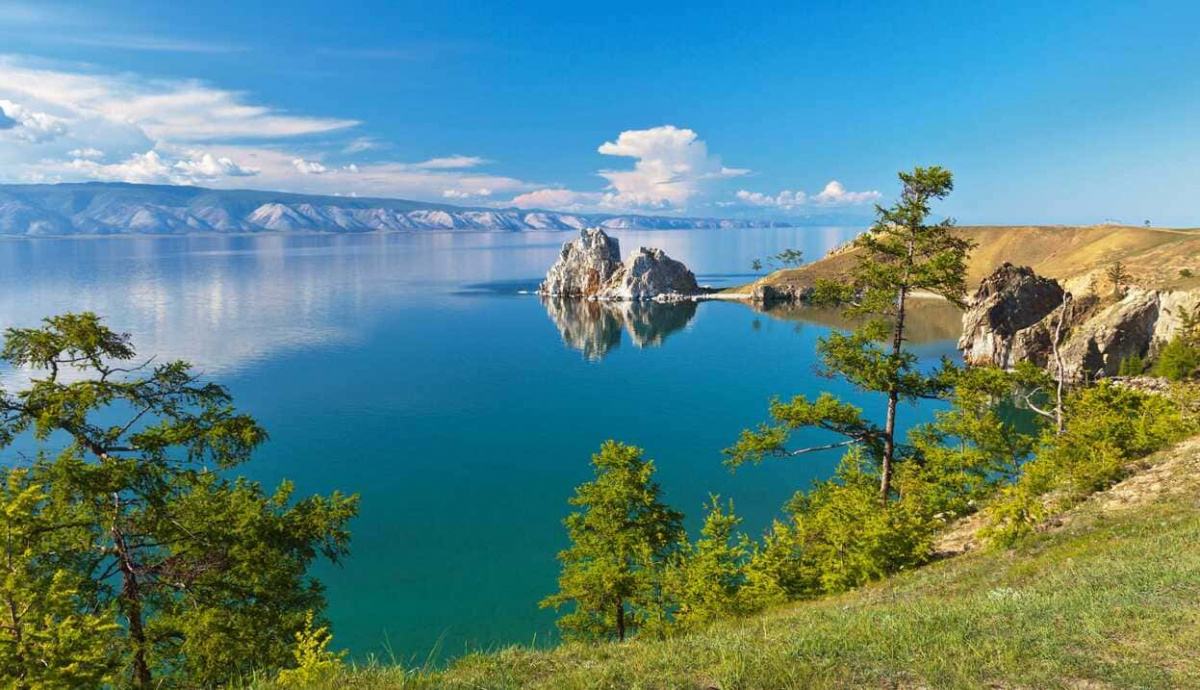
Lake Baikal contains 23,000 km³ of clean fresh water, which is 20% of the world’s reserves and 90% of Russia’s reserves. The Baikal ecosystem, formed over tens of millions of years and including the catchment basin, reproduces on average 60 km³ of water annually.
This volume, equal to 0.26% of total reserves, constitutes the renewable water resources of Baikal, which are currently used almost entirely both by hydropower, albeit in very small volumes, and by water intake facilities, including for the extraction of deep water for bottling.
The Baikal Natural Territory is an area that includes
- Lake Baikal,
- the water protection zone adjacent to Lake Baikal,
- its catchment area within the territory of the Russian Federation, specially protected natural areas adjacent to Lake Baikal,
- as well as the territory adjacent to Lake Baikal up to 200 kilometers wide to the west and northwest of it.
The boundaries of the Baikal Natural Territory and its environmental zones, as well as the boundaries of the water protection zone of Lake Baikal, have been entered into the Unified State Register of Real Estate (hereinafter the EGRN).
The legal regime in the central ecological zone of Lake Baikal is established by the current legislation of the Russian Federation, including:
● Decree of the Government of the Russian Federation of 31.12.2020 No. 2399 “On the approval of the list of types of activities prohibited in the central ecological zone of the Baikal Natural Territory” (hereinafter Decree No. 2399),
● Order of the Ministry of Natural Resources of Russia of February 21, 2020 No. 83 “On approval of standards for the maximum permissible impacts on the unique ecological system of Lake Baikal and a list of harmful substances, including substances belonging to the categories of extremely hazardous, highly hazardous, hazardous and moderately hazardous for the unique ecological system of Lake Baikal” (Registered with the Ministry of Justice of Russia on 23.04.2020 No. 58181) (hereinafter Order No. 83),
● Decree of the Government of the Russian Federation of 15.04.2014 No. 326 “On approval of the state program of the Russian Federation ‘Environmental Protection’”
Uniqueness of geography
Lake Baikal is located on the border of Irkutsk Region and the Republic of Buryatia; the southwestern part of Zabaykalsky Krai is included within the boundaries of the Baikal Natural Territory.
The total area of the Baikal Natural Territory, according to Rosreestr’s clarifications, in 2023 is 362,65 thousand km², of which the Central Ecological Zone accounts for 89,12 thousand km², or 24.6% of the entire area of the Baikal Natural Territory; the Buffer Ecological Zone — 190,04 thousand km² (52.4%); the Ecological Zone of Atmospheric Influence — 83,49 thousand km² (23%). Within the boundaries of the Baikal Natural Territory lie 53.9% of the territory of the Republic of Buryatia, 15.1% of the territory of Irkutsk Region, and 13.1% of the territory of Zabaykalsky Krai.
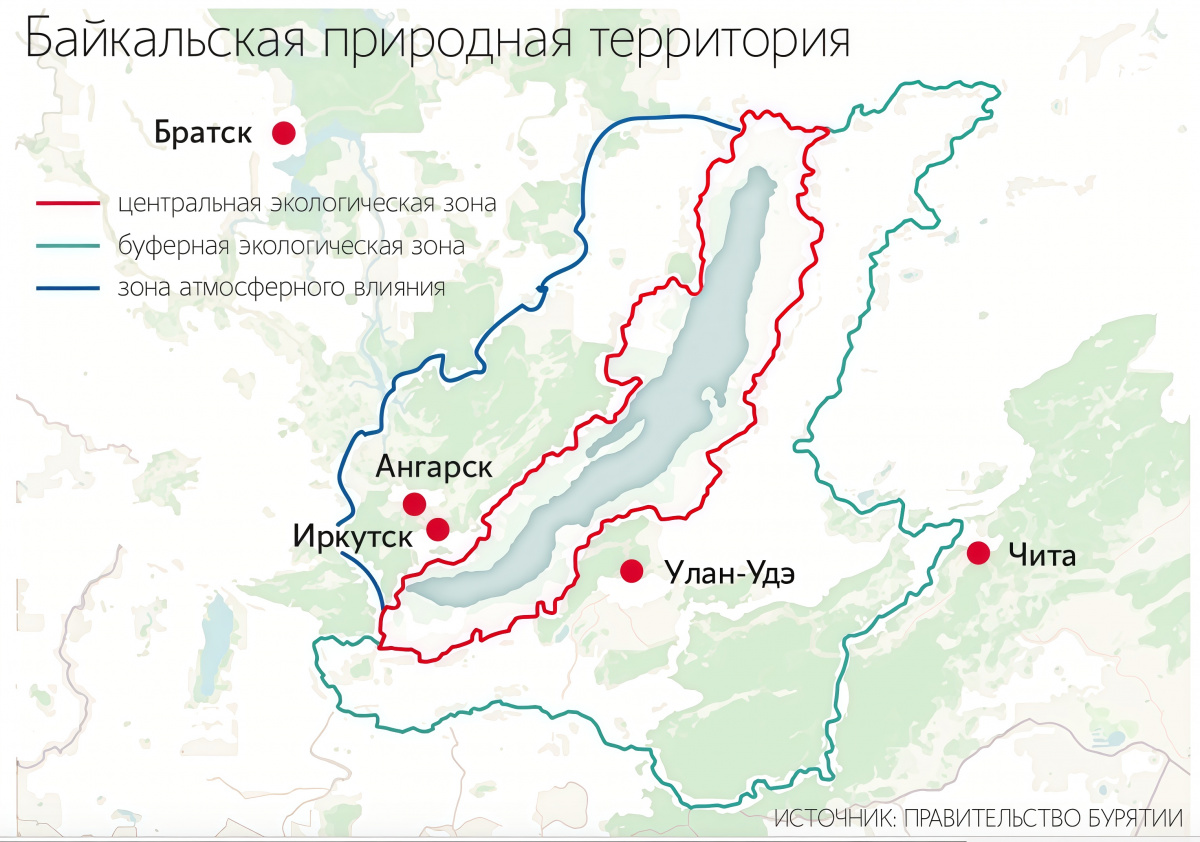
Fig. No. 1 The Baikal Natural Territory and the World Natural Heritage site “Lake Baikal”
The original source of this map-diagram is a publication by the Institute of Geography SB RAS (Irkutsk) on the website www.izdatgeo.ru: T.P. Kalikhman. The Baikal Natural Territory in the institutional model of nature protection.
Environmental zones of the BNT:
1 — central, whose outer boundaries coincide with the World Natural Heritage site “Lake Baikal”;
2 — buffer;
3 — atmospheric influence.
Boundaries:
4 — state,
5 — constituent entities of the Russian Federation,
6 — administrative districts,
7 — central ecological zone of the BNT and the World Natural Heritage site “Lake Baikal”,
8 — buffer ecological zone of the BNT,
9 — ecological zone of atmospheric influence of the BNT.
I — Irkutsk Region, II — Republic of Buryatia, III — Chita Oblast.
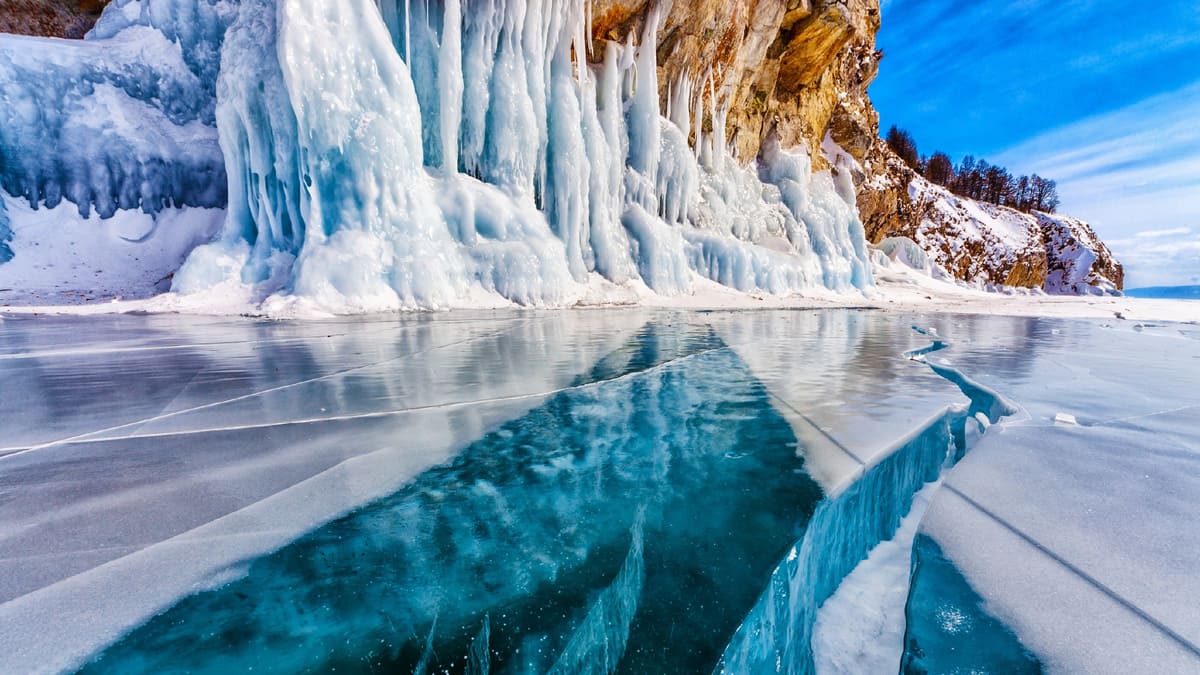
The following ecological zones are distinguished within the Baikal Natural Territory (BNT):
central ecological zone (CEZ) — a territory that includes Lake Baikal with its islands, the water protection zone adjacent to Lake Baikal, as well as specially protected natural areas adjacent to Lake Baikal;
buffer ecological zone (BEZ) — a territory outside the central ecological zone that includes the catchment area of Lake Baikal within the territory of the Russian Federation;
ecological zone of atmospheric influence (EZAI) — a territory outside the catchment area of Lake Baikal within the territory of the Russian Federation up to 200 kilometers wide to the west and northwest of it, on which economic facilities are located whose activities have a negative impact on the unique ecological system of Lake Baikal.
Anthropogenic impact on ecosystems
The lake is subject to eutrophication, experiences anthropogenic impact as a result of human economic activity, and also depends on natural hydrological conditions.
Damage to the natural territory and its ecosystems is also caused by:
● Fires, which can be of both natural and anthropogenic origin.
● Illegal logging, which leads to the destruction of ecosystems and loss of biodiversity.
● Poaching, which threatens rare species of flora and fauna.
● Spontaneously organized unauthorized dumps, which pollute the land and water bodies.
These factors underline the need for strict control and effective environmental protection measures in the region to preserve the unique ecosystem of Lake Baikal.
According to the State Report of the Ministry of Natural Resources of Russia_2023_lakes_Baikal_version_26122024, the main source of air pollution in the EZAI of the BNT is heat and power enterprises owned by LLC “Baikal Energy Company” (until September 1, 2020 — Public Joint-Stock Company “Irkutskenergo”).
These enterprises include: CHPP-9 and Site No. 1 of CHPP-9 (CHPP-1), CHPP-10 located in the city of Angarsk, Novo-Irkutsk CHPP in the city of Irkutsk, CHPP-11 in the city of Usolye-Sibirskoye, CHPP-12 in the city of Cheremkhovo, as well as the Shelekhov site of the Novo-Irkutsk CHPP located in the city of Shelekhov.
In 2023, at the enterprises of LLC “Baikal Energy Company” located in the EZAI of the BNT, the total gross emission of pollutants into the atmosphere increased by 17,478 thousand tons compared to 2022.
Table No. 1. Load on ambient air from LLC “Baikal Energy Company”
|
Name of pollutants |
Emitted into the atmosphere, thousand tons |
Change vs. 2022 |
|||
|
2021 |
2022 |
2023 |
thousand tons |
% |
|
|
Total pollutants, including |
185,648 |
213,922 |
231,400 |
+17,478 |
+8.2 |
|
Solid |
34,876 |
43,698 |
46,536 |
+2,838 |
+6.5 |
|
Gaseous and liquid, including: |
150,772 |
170,224 |
|
|
|
|
Sulfur dioxide |
124,48 |
137,015 |
153,903 |
+16,888 |
+1.3 |
|
Nitrogen oxides |
26,045 |
32,951 |
30,618 |
-2,333 |
-7.1 |
|
other |
0,247 |
0,258 |
0,343 |
+0,085 |
+32.9 |
The ecosystems of the BNT are subject to significant anthropogenic impact due to the operation of waste disposal facilities.
Landfills and unauthorized dumps have a detrimental effect on the atmosphere, the quality of surface and groundwater, and land.
In 2023, the implementation of the federal project “Conservation of Lake Baikal,” which is a component of the National Project “Ecology,” continued. The key objectives of the project are the conservation and restoration of bioresource potential, as well as the biological diversity of water bodies of the BNT. In addition, the project aims to reduce the anthropogenic load on the ecosystem of Lake Baikal. This includes a set of measures aimed at protecting unique ecosystems, improving the state of water resources, and ensuring the sustainable use of natural resources, which in turn will help preserve this natural heritage for future generations.
Reducing the total area of territories exposed to high and extremely high pollution and impacting Lake Baikal
In 2023, an unauthorized dump located near the village of Taloye within the boundaries of the Tunkinsky National Park with a total area of 15.9 ha was eliminated, and a site of unauthorized waste disposal was also eliminated on a land plot west of the village of Onguren in the Olkhonsky District of Irkutsk Region with an area of 0.057 ha within the boundaries of the Pribaikalsky National Park.
In the CEZ of the BNT, 17 unauthorized waste disposal sites with a total area of 26.28 ha were eliminated, including 7 dumps with an area of 2.89 ha in Irkutsk Region and 10 dumps with an area of 23.39 ha in the Republic of Buryatia.
In June 2023, under state contracts dated 14.04.2023 No. 1/2023ЕИ (for the elimination of accumulated environmental damage in the territory of the wastewater treatment facilities) and dated 14.04.2023 No. 2/2023ЕИ (for the elimination of accumulated environmental damage at the “Babhinsky” landfill), FSUE “FEO” began work to eliminate accumulated environmental damage at the “Babhinsky” landfill and on the territory of the wastewater treatment facilities shop of OJSC “BPPM”.
|
|
In accordance with Decree of the Government of the Russian Federation of 31.12.2020 No. 2399, the following are prohibited within the CEZ of the BNT: |

-
1. Burial and storage of radioactive waste.
-
2. Construction and reconstruction of especially hazardous and technically complex facilities, except for the construction and reconstruction within the boundaries of settlements of facilities for the collection, transportation, processing, recycling, neutralization of newly generated waste of hazard classes III–V; facilities for the placement of newly generated waste of hazard classes IV and V, excluding the burial of such waste.
-
3. Construction and reconstruction of especially hazardous and technically complex facilities, except for the construction and reconstruction within the boundaries of settlements of facilities for the collection and treatment of wastewater in terms of the treatment of wastewater from centralized water disposal (sewerage) systems.
-
4. Activities related to the management of newly generated production and consumption waste in terms of:
a) placement of production and consumption waste, except for waste of hazard classes IV and V at specially equipped facilities;
b) discharge into water bodies and burial in them of waste, as well as above-ground and underground burial of waste;
c) processing, neutralization or recycling of production and consumption waste outside the land plots on which waste processing, neutralization or recycling facilities are located;
d) neutralization or recycling of production and consumption waste by incineration without cleaning emissions to the approved standards.
Nevertheless, within the boundaries of the BNT, including the CEZ of the BNT, there are facilities for the placement (burial) of MSW. The list of such facilities is presented in Table 2.
More than 870 waste dumps are located near Lake Baikal in the districts of Buryatia, Irkutsk Region, and Zabaykalsky Krai, said the head of the Russian Ministry of Natural Resources Alexander Kozlov in an interview with Rossiyskaya Gazeta.
|
|
— We have completed the inventory in Irkutsk Region,
Zabaykalsky Krai and Buryatia,— Kozlov said. — We surveyed even the smallest dumps. As a result, we identified 872 sites: 305 in Irkutsk Region, 491 in the Republic of Buryatia and 76 in Zabaykalsky Krai. |
The regional authorities propose including 597 of these dumps in the state register of environmentally hazardous sites in order to find sources of funding for their elimination.
Thus, the state policy and the development vector of the sector within the boundaries of the BNT are aimed primarily at eliminating landfill burial of waste and preventing the creation of new sources of pollution of the unique nature.
Table No. 2. Waste disposal facilities in the territory of Irkutsk Region.
|
No. |
Name of the operating facility |
Location address |
Name of the new facility provided for by the territorial scheme, federal scheme and regional program |
Risks of putting the facility into operation by 01.01.2026 (yes/no) |
Note |
|
1 |
MSW landfill, Tulun |
Tulunsky District, Tulun, on the left side 5 km along the Bratsk highway to the north, cadastral number: 38:30:010601:107 |
Landfill for the placement of municipal solid waste with a sorting line, an incinerator unit and a membrane composting site in Sayansk |
In case of lack of financing |
If not commissioned by 01.01.2026, an alternative solution is planned for MSW placement during the transition period. Solid waste landfill in Irkutsk District (in the GRORO No. 38-00037-3-870-311214) MSW landfill in Angarsk (in the GRORO No. 38-00011-Z-00479-010814) |
|
2 |
MSW landfill, village of Osa |
Osinsky District, from the landmark — village of Osa, 4 km to the south, Kamenskaya gully, cadastral number: 85:05:040613:173 |
Osinsky District, landfill for the placement of municipal solid waste with a sorting line |
In case of lack of financing |
Alternative solution for MSW placement during the transition period. MSW landfill in the city of Cheremkhovo (in the GRORO No. 38-00037-3-870-311214) Landfill in Cheremkhovsky District (commissioned in 2022) MSW landfill in Zalarinsky District (in the GRORO No. 38-00222-Z-00198-130618) |
|
3 |
MSW landfill, city of Zima |
Ziminsky District, Uslonskoye municipal formation, east of the village of Cheleba, Yasnaya Polyana tract, plot No. 3 (solid waste landfill), cadastral number: 38:05:0841101:330 |
Landfill for the placement of municipal solid waste with a sorting line, an incinerator unit and a membrane composting site in Sayansk |
In case of lack of financing |
If not commissioned by 01.01.2026, an alternative solution is planned for MSW placement during the transition period. Solid waste landfill in Irkutsk District (in the GRORO No. 38-00037-3-870-311214) MSW landfill in Angarsk (in the GRORO No. 38-00011-Z-00479-010814) |
Another 12 authorized facilities for the placement of industrial and household waste are located within the boundaries of the BNT: the household waste landfill of Olkhonsky District, the MSW burial site of Usolsky District, the solid waste landfill of Angarsk, the MSW landfill of Irkutsk, the solid waste landfill of Cheremkhovo, the solid waste landfill of Svirsk, the solid waste landfill “Kazachinsko-Lensky District,” the MSW landfill “Slyudyansky District,” the solid waste landfill of Cheremkhovo, the MSW landfill in the village of Osa, the industrial and household waste landfill of JSC “ANKHK,” the industrial and household waste landfill (The Territorial Waste Management Scheme in Irkutsk Region was approved by Order of the Ministry of Natural Resources and Ecology of Irkutsk Region dated December 29, 2017 No. 43-mpr).
In the territory of Irkutsk Region, according to the data of local governments of municipal formations of Irkutsk Region, and based on the results of oversight activities carried out by the Interregional Directorate of Rosprirodnadzor for Irkutsk Region and the Baikal Natural Territory, and by the State Environmental Supervision Service of Irkutsk Region, sites of unauthorized waste disposal have been identified in the territory of Irkutsk Region.
The implementation of the activities of the federal project “Conservation of Lake Baikal” was carried out in all three regions whose municipalities are part of the BNT — Irkutsk Region, the Republic of Buryatia and Zabaykalsky Krai.
Since 2020, the area of territories exposed to high and extremely high pollution and impacting Lake Baikal has been reduced by 214.13 ha. In 2023, an unauthorized dump located near the village of Taloye within the boundaries of the Tunkinsky National Park with a total area of 15.9 ha was eliminated, as well as a site of unauthorized waste disposal on a land plot west of the village of Onguren in the Olkhonsky District of Irkutsk Region with an area of 0.057 ha within the boundaries of the Pribaikalsky National Park; 17 unauthorized waste disposal sites with a total area of 26.28 ha were also eliminated, including 7 dumps with an area of 2.89 ha in Irkutsk Region and 10 dumps with an area of 23.39 ha in the Republic of Buryatia.
The implementation of such measures is of great importance for the environmental rehabilitation of Lake Baikal and the preservation of its unique nature, which in turn contributes to improving the quality of life of the population living in this region.
Effective methods for processing MSW within the BNT
Characteristics of MSW
The main factors affecting the quantitative characteristics of MSW in any settlement are the conditions of waste generation, which include:
- population size and density;
- the level of housing amenities (availability of sewerage, centralized heating and heat supply, number of stories and availability of a waste chute);
- climatic and other natural conditions, and others.
However, MSW is always waste with a complex multicomponent composition.
Table No. 3. Example of the morphological composition of MSW
|
No. |
Component |
Percentage content, % by mass |
|
1 |
paper and cardboard |
33-40 |
|
2 |
food waste |
27- 33 |
|
3 |
wood |
1.5-5 |
|
4 |
ferrous metal |
2.5-3.6 |
|
5 |
non-ferrous metal |
0.4-0.6 |
|
6 |
bones |
0.5-0.9 |
|
7 |
leather and rubber |
0.8-1.3 |
|
8 |
textiles |
4.6-6.5 |
|
9 |
glass |
2.7-4.3 |
|
10 |
polymer materials |
4.6-4.8 |
The morphological composition of waste predetermines its calorific value and physico-chemical properties, and therefore the approach to choosing the optimal processing technology.
Table No. 4. Indicative fractional composition of MSW
|
Component |
Fraction size, mm |
||||
|
over 250 |
150-250 |
100-150 |
50-100 |
under 50 |
|
|
Paper, cardboard |
3 – 8 |
8 - 10 |
9 - 11 |
7 - 8 |
2 - 5 |
|
Food waste |
- |
0 - 1 |
2 - 10 |
7 - 12.6 |
17 - 21 |
|
Wood |
0.5 |
0 - 0.5 |
0 - 0.5 |
0.5 |
0 - 0.5 |
|
Metal |
- |
0-1 |
0.5 - 1 |
0.8 - 1.6 |
0.3 - 0.5 |
|
Textiles |
0.2 - 1.3 |
1 - 1.5 |
0.5 - 1 |
0.3 - 0.8 |
0 - 0.6 |
|
Plastics |
0 - 0.2 |
0.5 - 1 |
1 - 2.2 |
1 - 2.5 |
0.2 - 0.5 |
|
Glass |
- |
0 - 0.3 |
0.3 - 1 |
1 - 2 |
1 - 1.6 |
|
Bones |
- |
- |
- |
0.3 - 0.5 |
0.5 - 0.9 |
|
Leather, rubber |
- |
0 - 1 |
0.5 - 2 |
0.5 - 1.5 |
- |
|
Stones, plaster |
- |
- |
0.2 - 1 |
0.5 - 1.8 |
0.5 - 2 |
|
Other |
0 - 0.3 |
0.2 - 0.6 |
0 - 0.5 |
0 - 0.4 |
0 - 0.5 |
|
Screenings |
- |
- |
- |
- |
4 - 6 |
|
Total |
7.0 |
13.3 |
22.1 |
25.3 |
32.3 |
Table 5. Calculated elemental composition of waste
|
Name of waste |
C, % |
H, % |
O, % |
N, % |
S, % |
Cl, % |
W, % |
A, % |
Q, kcal/kg |
Cp, J/(kg×֯C) |
|
Mixed waste |
24.360 |
3.110 |
18.693 |
0.721 |
0.123 |
0.255 |
35.129 |
17.575 |
2038 |
2500 |
where C, H, O, N, S, Cl, W, A are the contents of carbon, hydrogen, oxygen, nitrogen, sulfur, chlorine in the waste, and the moisture and ash content of the waste;
Q is the lower calorific value of the waste mixture, kcal/kg
Cp is the specific heat capacity of the waste, J/(kg×֯C)
Methods of energy recovery of MSW
<


