


We often receive requests to select equipment for the neutralization of biological waste, in particular animal carcasses. At first glance, the process seems logical and clear: the client studies the catalog, chooses an incinerator with a stated load, for example, 500 kilograms, and places an order. However, in practice, it’s not that simple. During tenders we often encounter situations where the technical specification is drawn up with errors — parameters for mass and volume are indicated, but the actual dimensions of the waste are not taken into account.
What clients ask:
- How to avoid mistakes when choosing an incinerator for burning animal carcasses
- Why it is important to consider the dimensions of the waste when selecting an incinerator
- How to correctly draft a technical specification for an incinerator for the disposal of biological waste
- Incinerator for burning animal carcasses: what to pay attention to when choosing
- Error in the technical specification: how a customer can end up with an unsuitable incinerator
- Choosing an incinerator for oversized waste: expert tips
- Incinerators for disposing of animal carcasses: how to avoid costly mistakes
- Why an incinerator with a 1 m³ volume may not handle a moose carcass
ECO-SPECTRUM does not participate in such disputable situations and does not get involved in tenders where there is a risk of error due to insufficient customer qualifications. We understand that such decisions can negatively affect our company’s reputation as a supplier and also the efficiency of equipment use. In this article, we will explain how to avoid such mistakes and provide a real example — a request to purchase an incinerator for the disposal of moose carcasses.
The information provided will be useful for potential clients looking for equipment to dispose of animal carcasses.
How to choose an incinerator for burning animal carcasses: key criteria and recommendations
Disposal of animal carcasses is an important stage in the work of veterinary institutions, farms, laboratories, and other organizations where there is a need for safe handling of biological waste. For this, special equipment is used — incinerators. However, choosing the right model requires a careful approach, especially when it comes to oversized waste.
In this article, we will explain which parameters to pay attention to when selecting an incinerator and why VOLKAN 1750 is the optimal solution for burning large animal carcasses.
Why it is important to consider the dimensions of the loaded waste
When choosing an incinerator, people often focus on the volume of the combustion chamber and the maximum load mass. For example, a chamber with a volume of 1 m³ can accept up to 500 kg of waste. However, in the case of animal carcasses, not only the mass and volume are key, but also the dimensions of the object being loaded.
If the carcass dimensions exceed the internal dimensions of the chamber, even at a mass lower than the permissible one, loading may be impossible. In addition, it is important to ensure even burning and sufficient space for oxygen to reach the combustion zone. For this, there must be free space — a gap — between the waste and the burner flame cup, which helps with:
- even distribution of heat;
- preventing the burner flame from being blocked;
- maintaining stable combustion and complete burnout.
Main criteria for choosing an incinerator
When selecting an incinerator, we recommend considering the following parameters:
1. Combustion chamber dimensions — width, height, depth. They must match the size of the loaded waste.
2. Ability to load oversized objects — the presence of doors or hatches of the appropriate size.
3. Providing an oxygen gap — the chamber must be spacious enough so that the load does not block air access to the burner.
Comparative characteristics of the incinerator


|
Incinerators |
Combustion chamber volume (m3) |
Afterburning chamber volume |
Load (kg)
|
Footprint (LxWxH) |
Loading opening size |
|
VOLKAN 500 |
0.92 |
1.08 |
up to 500 |
2.6x2.3x3.3 m |
1.5x0.9 m |
|
VOLKAN 1750 |
3.71 |
1.02 |
up to 1750 |
4.3x4.6x3.45 m |
2.2x1.8 m |
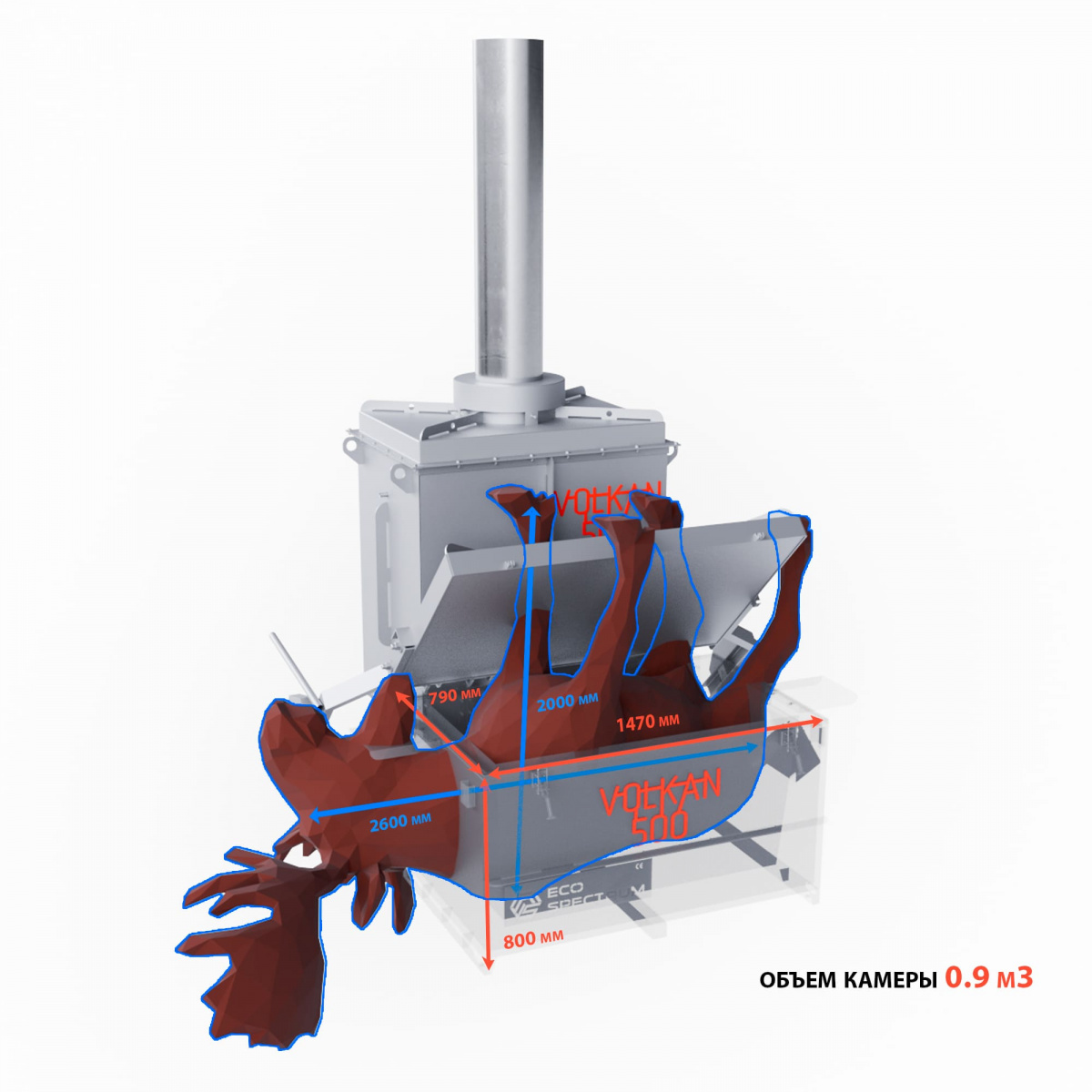
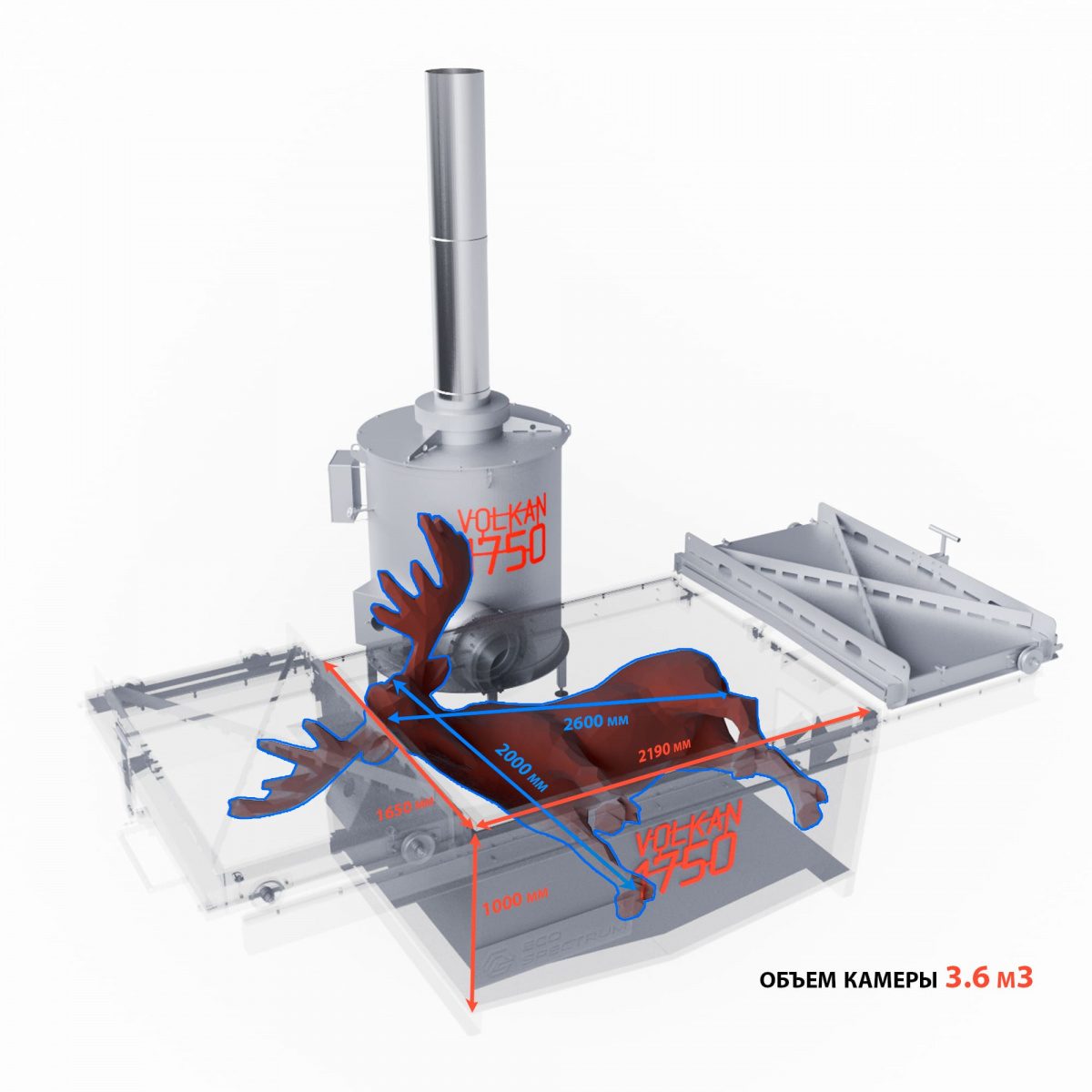
For a visual understanding of the specifics of loading waste into an incinerator, we have prepared a visualization comparing how animal carcasses are placed in the combustion chamber. This visualization makes it possible to assess how important the equipment dimensions are when working with oversized waste.
The images show that even with a smaller load than the chamber allows, an animal carcass may not fit if its dimensions exceed the internal dimensions of the incinerator. This underscores the need to choose equipment with appropriate internal dimensions to enable single-load operation without prior cutting.
|
VOLKAN 500 |
VOLKAN 1750 |
|
|
VOLKAN 1750 — the optimal solution for burning oversized waste
For the disposal of large animal carcasses, such as a moose carcass, the VOLKAN 1750 incinerator developed by ECO-SPECTRUM is ideal. The volume of the combustion chamber allows single-load handling of large-size waste without prior cutting, which significantly simplifies and speeds up the processing.
Key features of the model:
-
Sloped bottom and sloped lid providing convenient loading and unloading, as well as efficient removal of bodily fluids.
-
Concrete lining with a protective ceramic fiber layer that serves as thermal insulation, helps retain heat in the chamber, saves fuel, and prevents overheating of the metal casing.
-
High capacity, enabling single-load handling of large objects without prior preparation.
-
Thanks to the sloped bottom, bodily fluids accumulate in the lower part of the chamber, accelerating the disposal process and improving the overall efficiency of the incinerator.
Why VOLKAN 1750 is better than VOLKAN 500
The visualization shows that the VOLKAN 500 incinerator is not the optimal choice for burning oversized waste such as a moose carcass. For such tasks, a model with increased internal dimensions and a suitable chamber design is required.
VOLKAN 1750 is a unique model that is ideal for processing oversized waste. It combines reliability, advanced technology, and ease of operation.
Conclusion
Choosing an incinerator is a responsible decision that affects the efficiency and safety of waste disposal. Consider not only the volume and mass of the load, but also the actual dimensions of the waste to avoid blocking the burner flame and to ensure stable combustion.
The VOLKAN 1750 incinerator is a reliable, technologically advanced, and legally approved solution for the effective disposal of oversized waste. The entire ECO-SPECTRUM line of incinerators has a positive opinion from the State Expert Review (GosExpertiza, GEE)**, which significantly simplifies obtaining permits for waste disposal activities.


