


Ваша заявка принята!
Наш менеджер свяжется с Вами
в течение 2 минут!
Рабочее время 8:00-17:00 (МСК)
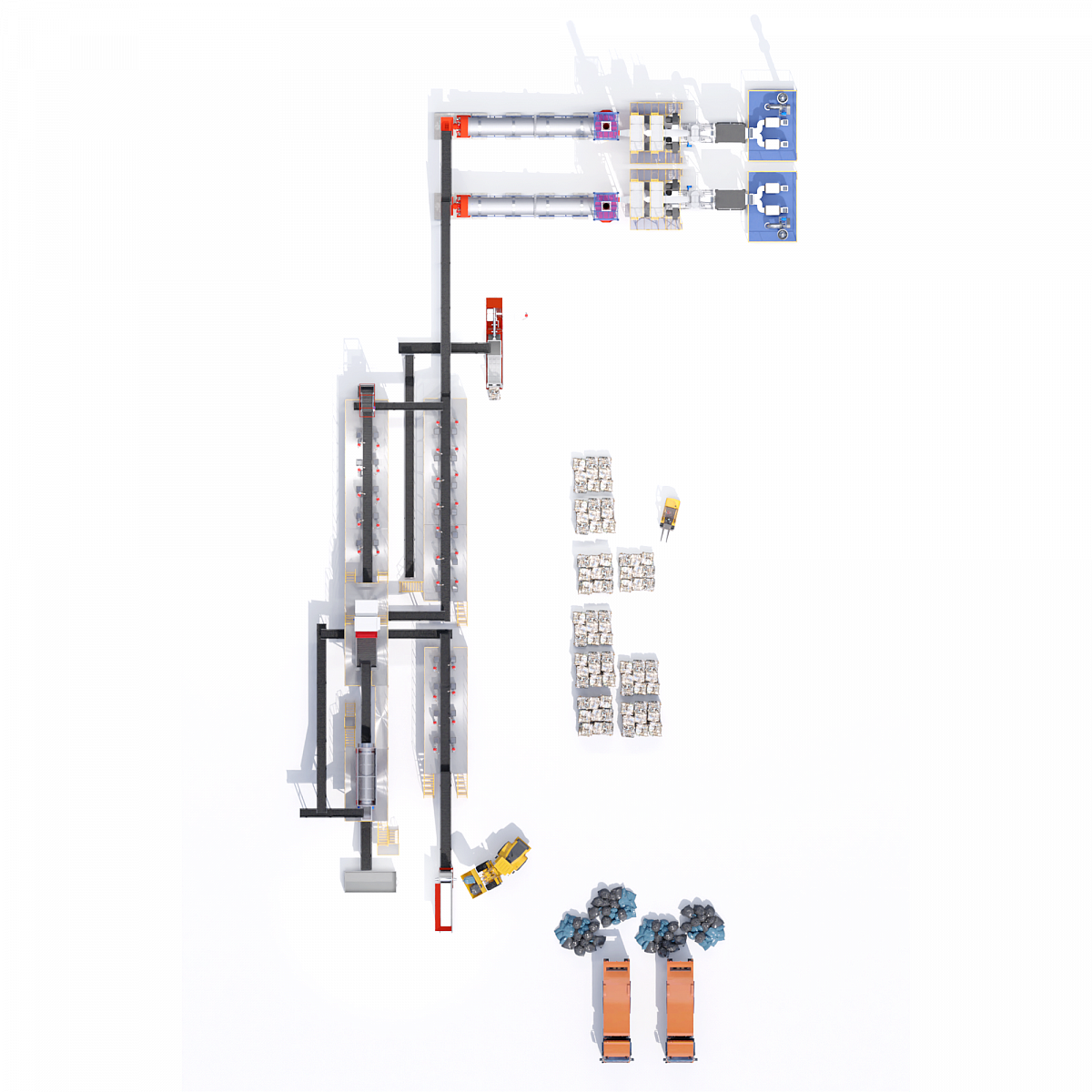

The MSW "SK-250" sorting complex consists of two parallel sorting lines. Each of the sorting lines includes: feeding and sorting conveyors, pre- and main sorting platforms, magnetic and drum type separators, and it is also possible to use additional equipment to automate sorting processes.
The sorting complex of MSW "SK-250" from the company "Eco-Spectrum" is suitable for a settlement with a population of up to 500 thousand people. The complex is designed for sorting up to 250,000 tons/year, using only 48 sorting posts, while working 16 hours a day.
In the “Basic” version, the complex provides a capacity of up to 200,000 tons/year, using only 52 sorting posts, while working 16 hours a day.
In the “Standard” version, the productivity of the complex can be increased to 250,000 tons/year by retrofitting with package breakers, optical separators, as well as a pre-sorting platform with cullet sampling posts.
In the “Standard+” version, the “Standard” configuration can be supplemented with a thermal tailings destructurization site and a technical soil production site.
The “Basic” variant of the MSW "SK-250" sorting complex consists of:
The “Standard” variant of the MSW "SK-250" sorting complex consists of:
The "Standard+” variant of the MSW "SK-250" sorting complex consists of:
The company “EkoSpectrum” carries out individual projects of waste sorting complexes according to the customer's technical specifications.

Environmental and economic impact

Note:
The CLC fragments are loaded into a storage container with a capacity of 30 m3 and then transported to the CLC site for processing or burial. A shredder can be provided, a crusher for crushing is optional. The crushed CGO can be sent to the thermal neutralization line, except for inclusions of concrete and reinforced concrete.

The estimated amount of sampling is 45% of the total volume


Optional retrofitting with containers for collecting VMR is possible. It is also possible to dump VMR onto sites that are already equipped with partitions to exclude mixing, which are collected by a loader from the site
The estimated amount is 3-5% of the total volume

Automatic cleaning
Continuous purification from magnetic impurities takes place automatically and does not require the participation of personnel.

It is possible to provide automatic conveyor feeding, additional design is required and linking to the site according to the location of all facilities of the processing line

Waste disposal unit (HURIKAN 2000 R incinerator):
Gas purification unit (dry gas purification):
It is possible to use a "wet" type gas purification system.
The choice of the type and configuration of the GO is determined by the requirements of the SPZ, the morphological composition, the technical conditions of the site and the climatic conditions of operation

The quality control of the release of pollutants into the atmosphere is carried out in accordance with the schedule approved by the operating organization from the chimney after the GO (the list of normalized indicators was approved by the Order of the Ministry of Natural Resources of the Russian Federation dated 12.11.2021 No. 844). The concentration of SV in the industrial discharge will be influenced by the morphological composition of the waste, the presence / absence of deviations from the recommended operating mode of the equipment.
As a result of the dispersion of emissions in the atmosphere, the concentration of pollutants at the border of the sanitary protection zone (SPZ) will reach safe levels for the life and health of citizens. Thus, in order to ensure public control over the quality of the environment in the area of operation of the MSW waste disposal facility, we recommend installing automatic measurement systems for atmospheric air at the border of the SPZ.
The size of the SZZ for the H2000R installation is 500 m. A reduction in the size of the SPZ is acceptable if it proves that the effects on atmospheric air have been achieved up to the maximum permissible concentration and maximum control
Note:
Automatic monitoring of the state and dynamics of changes in the radiation background and the level of atmospheric air pollution along the perimeter of the SPZ will ensure public control over the preservation of proper environmental quality and, as a result, increase the level of public confidence in waste treatment facilities. The transparency of the MSW waste movement and processing scheme will stimulate the strengthening of the Krasnodar Territory's image as an environmentally responsible region. The proposed project may become a pilot project for further scaling both within the region and throughout the Russian Federation.
*The equipment is not included in the price of the complex
Waste disposal includes the use of municipal solid waste as a renewable energy source (secondary energy resources) after extracting useful components from them at processing facilities that meet the requirements provided for in paragraph 3 of Article 10 of this Federal Law "On Production and Consumption Waste" (energy disposal).
The proposed project allows you to:
* To extract thermal and electrical energy, additional equipment modules will be required, as well as a technological solution for using the received energy.
Ash residue application (disposal)
The waste sent to the Plant for disposal may contain refractory, non-flammable substances that turn into ash. Their presence affects the ash content: the volume and composition of the residue.
The determination of the component composition and hazard class of the ash residue by the experts of the testing laboratory makes it possible to resolve the issue of the possibility of its further processing or use.
It is possible to equip CO2 capture equipment for the purpose of commercialization as a BMP.

The high quality of our products is ensured by a high level of input quality control of materials and control at every stage of production, up to factory tests of each node and equipment as a whole.
Increasing the service life and reducing the wear of components and aggregates of conveyor equipment is due to the use of a complex of engineering solutions developed based on the analysis of equipment operation and customer feedback.
The technologies that we create are the best available technologies that combine modern achievements of science and technology, as well as practical solutions to the strategic tasks of the state in the field of environmental protection, meeting national and international standards.
Licensing of waste management activities is carried out by the Federal Service for Supervision of Environmental Management.
Mandatory requirements for obtaining a license for the neutralization/disposal of hazard class I-IV waste:
Note: The equipment has received a positive conclusion from the State Environmental Assessment of Rosprirodnadzor


Eco-Spectrum has a license for the right to provide educational services. Each installation operator is trained, receives the profession of "Installation Operator", and receives a certificate of advanced training.
The company provides these services free of charge

Рабочее время 8:00-17:00 (МСК)
Рабочее время 8:00-17:00 (МСК)
Рабочее время 8:00-17:00 (МСК)
Рабочее время 8:00-17:00 (МСК)
Нажимая на кнопку, Вы даете согласие на обработку персональных данных.